
.webp?width=387&height=387&name=headless-tprm%20(1).webp)




























Third-Party Risk Management
ComplyScore® Launches World’s First Headless TPRM, Bringing Conversational AI to Compliance Management. 
ComplyScore® Launches World’s First Headless TPRM, Bringing Conversational AI to Compliance Management.



According to PwC, the average cost of a data breach is US$3.3 million. As organizations expand across cloud, SaaS, and third-party environments, their digital attack surface continues to grow creating more entry points for attackers.
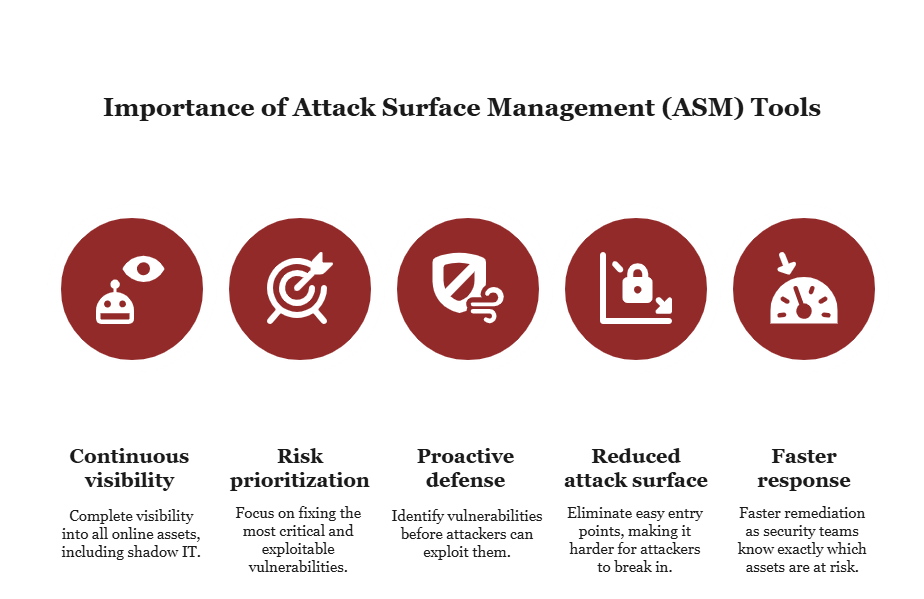
Attack surface management tools help security teams continuously discover, monitor, and prioritize exposed assets before they can be exploited. By providing real-time visibility into internet-facing infrastructure, ASM solutions reduce blind spots and strengthen overall security posture.
This guide explores the best attack surface management tools and how to choose the right solution for your organization.
Attack surface management tools are security platforms that continuously discover, analyze, and monitor an organization’s digital assets to identify exposed vulnerabilities from an attacker’s perspective.
These tools map:
Unlike traditional vulnerability scanners that focus on known systems, attack surface management tools assume unknown exposure exists and proactively uncover hidden risks across cloud, hybrid, and third-party environments.
The following comparison highlights the best attack surface management tools in 2026, including asset discovery capabilities, risk prioritization features, compliance support, and pricing structures to help organizations select the right ASM solution.
|
Name |
Best For |
Standout Feature |
Pricing |
|
ComplyScore® by Atlas Systems |
Medium or large enterprises in highly regulated industries like finance, healthcare, and manufacturing |
Integrates external attack surface management into its risk assessments to detect vulnerabilities and potential access points that attackers might exploit |
Custom pricing |
|
Microsoft Defender XDR |
Organizations with complex threat profiles that need advanced detection and extended response |
Provides visibility across the full cyberattack chain and automatically disrupts attacks in real time. |
Custom pricing |
|
Google Cloud Security by Mandiant |
Organizations with a multi-cloud or hybrid-cloud setup in high-risk sectors |
Combines Mandiant's threat hunting and incident response expertise with Google Cloud’s security operations platform |
Custom pricing |
|
CrowdStrike Falcon Surface |
Companies that want a scalable, cloud-native platform for advanced endpoint protection, threat detection, and response |
The Threat Graph, a cloud database and analytics engine, collects and correlates multiple security events in real-time |
Falcon Go ($59.99/device/year), Falcon Pro ($99.99/device/year), Falcon Go ($184.99/device/year) |
|
Palo Alto Cortex Xpanse |
Large enterprises that want to continuously discover and protect their entire digital presence |
Continuously scans the entire internet to identify and monitor exposed assets and vulnerabilities |
Custom pricing |
|
UpGuard |
Organizations in highly regulated industries with many third-party dependencies |
Uses AI-powered tools to accelerate assessment and find security gaps |
Free ($0/month), Starter ($1599/month), Professional ($1599/month), Enterprise (customized pricing) |
|
CyCognito |
Enterprises with complex digital ecosystems, such as assets across various cloud providers |
Its attack surface management platform sees an organization’s digital assets from an attacker’s point of view |
Custom pricing |
|
BitSight |
Companies looking to assess and manage the cybersecurity risks of their partners and third parties |
Daily security ratings give an evidence-based score of an organization's cybersecurity performance |
Custom pricing |
|
Qualys |
Companies looking for a unified platform to manage their cybersecurity and compliance programs |
The Enterprise TruRisk Platform provides continuous, real-time security across the entire IT landscape |
Custom pricing |
ComplyScore® by Atlas Systems performs attack surface management through direct scanning and integration with third-party tools. It works together with Tenable to deliver web application scans, vulnerability scans, and dedicated attack surface management scans. ComplyScore® pairs ASM scans with compliance and vendor risk management processes, helping organizations understand their external exposure and how to address risks.
"I have been using ComplyScore® for several months, and my experience has been largely positive. The platform provides comprehensive solutions for compliance management, streamlining our operations efficiently."
Reviewer: IT Security & Risk Management Associate
Industry: IT Services
Source: Gartner

This ASM software is ideal for organizations already using Microsoft security solutions, as it integrates seamlessly with the larger Microsoft ecosystem. It offers visibility into a company’s public-facing endpoints by identifying unknown or forgotten assets that could become points of attack.
Mandiant’s suite of threat intelligence, detection, and response services and products is integrated into Google Cloud's security offerings to combat advanced cyber threats for both cloud and on-premises environments. The platform provides insights to strengthen a company’s cybersecurity posture.
Falcon Surface is part of CrowdStrike’s ASM cybersecurity tools. It gives a complete picture of an organization’s attack surface, covering cloud, on-premise, and hybrid assets.
Cortex Xpanse is an attack surface management tool that provides organizations with continuous, automated visibility into their external digital assets and the associated risks. It also gives insights into what attackers target and how to defend against them.
Organizations use UpGuard for internal and third-party attack surface monitoring. By continually evaluating the security postures of external entities, they protect themselves against supply chain vulnerabilities and potential data breaches.
CyCognito discovers potential risks by modeling adversary tactics, techniques, and procedures (TTPs). It also discovers shadow IT and hidden assets, helping organizations address hidden risks that are not discoverable by traditional tools.
This is one of the top attack surface monitoring tools in the marketplace. It uses analytical forecasting to estimate an organization’s future security performance. It helps organizations mitigate cyber risks by tracking vulnerabilities and prioritizing critical issues.
This cloud-based ASM tool provides asset discovery and continuous monitoring of digital assets. It helps organizations to secure their external digital footprint by running vulnerability assessments and prioritizing threats to allow for timely mitigation.
Incomplete visibility across cloud, third-party vendors, and internet-facing assets creates blind spots that attackers actively exploit. Without continuous monitoring, unknown exposures can remain undetected until a breach occurs.
ComplyScore® by Atlas Systems delivers continuous attack surface visibility by integrating external scanning, risk prioritization, and compliance workflows into a unified platform. It helps security and risk teams identify exposed assets, assess exploitability, and trigger remediation workflows before threats escalate.
Designed for regulated industries, ComplyScore® aligns attack surface management with governance, risk, and third-party risk management processes ensuring security controls are measurable, auditable, and proactive.
See how Atlas Systems can help you reduce exposure and improve cyber resilience. book a demo call today..
Attack Surface Management (ASM) is the continuous process of discovering, analyzing, and monitoring an organization’s digital assets to identify security exposures before attackers can exploit them.
ASM tools automatically map internet-facing infrastructure, cloud resources, APIs, domains, identities, and third-party connections to uncover unknown or unmanaged assets. By providing an attacker’s outside-in perspective, ASM helps organizations reduce blind spots, prioritize vulnerabilities, and strengthen their overall security posture.
Attack Surface Management (ASM) continuously discovers and monitors all internal and external digital assets, including unknown or shadow IT exposures. Vulnerability management focuses on scanning known systems for documented software flaws. ASM provides an attacker’s outside-in view of the entire attack surface, while vulnerability management primarily identifies patchable weaknesses within already cataloged assets.
Leading attack surface management tools for 2026 include ComplyScore® by Atlas Systems, Microsoft Defender External Attack Surface Management, CrowdStrike Falcon Surface, Palo Alto Cortex Xpanse, Wiz, CyCognito, UpGuard, BitSight, and Qualys. These platforms provide continuous asset discovery, risk prioritization, threat intelligence integration, and automated remediation capabilities.
Attack Surface Management supports compliance by continuously identifying exposed assets, misconfigurations, and security gaps that may violate regulatory standards such as NIST, PCI DSS, HIPAA, or GDPR. ASM tools provide audit-ready reporting, real-time monitoring, and risk documentation to demonstrate proactive security controls and ongoing compliance posture.
Yes. Hybrid and multi-cloud environments significantly expand digital exposure through cloud services, APIs, third-party integrations, and remote access points. ASM is essential in hybrid environments because it continuously discovers unknown assets, monitors cloud misconfigurations, and prioritizes risks across distributed infrastructure where traditional security tools often lack full visibility.

%20(1).jpg)